


Giving meaning to noise, sound becomes communication

That conviction comes out of my own practice. I hold an MFA from the School of the Art Institute of Chicago, where I explored improvisation with invented instruments, phonography, and found objects, and composed in the tradition of musique concrète. That work demanded experimentation, critical listening, and treating audio technology as a creative tool rather than just a technical one — and it shapes everything I teach.
I teach because I want students to shape culture on their own terms—building an artistic voice alongside the practical skills to turn it into a career.
I teach technology in three steps:
-
Start with the physics—the objective parameters of how a tool works.
-
Put hands on it, experimenting to hear what it actually does.
-
Use that understanding to make deliberate choices in real projects.
Conventional or experimental, the goal is the same: students should understand the consequences of every technical choice. The results a tool produces are objective; whether to use it is a subjective call that depends on the work in front of you.
Course & Workshop Topics
-
Audio Recording Techniques
-
Digital Audio Production (Pro Tools, Logic)
-
Audio Post-Production for Film
-
Sound Design for Animation & Film
-
Synthesis (Subtractive, FM, Granular)
-
Fundamentals of Electronic Music
-
Physics of Sound & Acoustics
-
Field Recording
-
Phonography Performance
-
Invented Instruments — building & improvising
-
Alternative Transducers (contact mics, hydrophones, induction coils)
Examples of classroom activities
 Synthesis & Sound Design - Mira Costa CollegeStudents use the Moog Mother32 to learn basic concepts of synthesis |  Audio Systems Design and Maintenance - San Diego Miramar CollegeStudents learn basic soldering skills. Here, they are making 1/4" TRS cables that they then keep. |  Audio Systems Design and Maintenance - San Diego Miramar CollegeUsing breadboards, students learn the basics of electricity and simple components. |
|---|---|---|
 Audio Systems Design and Maintenance - San Diego Miramar CollegeFinding out the value of a resistor |  Audio Systems Design and Maintenance - San Diego Miramar CollegeI created thorough step by step instructions on how to create simple circuits. | 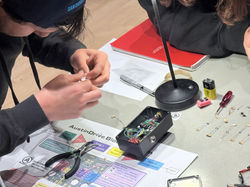 Audio Systems Design and Maintenance - San Diego Miramar CollegeStudents learn the role of capacitors, resistors, and diodes by swapping out these components in guitar pedals. |
 Audio Systems Design and Maintenance - San Diego Miramar CollegeRick Wilkinson, of Austin Ribbon Mics, shows students his circuit diagrams for his guitar pedals, and then demonstrates how to swap out components to change the tone of the pedal |  Audio Systems Design and Maintenance - San Diego Miramar CollegeHere, a student connects a guitar pedal after switching out components that change the tone. |  Audio Systems Design and Maintenance - San Diego Miramar CollegeA student discovers that his fingers act as variable capacitors in this circuit! |
 Audio Systems Design and Maintenance - San Diego Miramar CollegeIn an attempt to predict the RT60 of the main studio, students take measurements of the space and all the materials in the space. They then enter that info into a spreadsheet, and using the absorption coefficients of the various materials, calculate the reverb time. |  Sampling and Sound Design - CSUStudents experiment with contact mics in a piano to collect sounds to process and sample |  Sampling and Sound Design - CSURunning a recording session where students record a variety of percussive sounds in order to make an industrial percussion sample set. |
 Sampling and Sound Design - CSUStudents make contact mics to use in our recording sessions. | 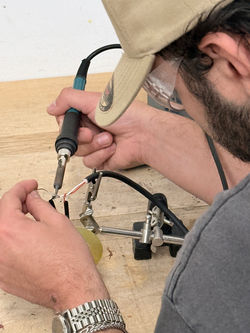 Sampling and Sound Design - CSUStudents make contact mics to use in our recording sessions. | 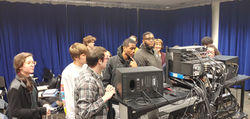 First Year Audio Recording 3 - Shoreline Community CollegeStudents learn signal routing through the use of analog consoles and block signal diagrams. |
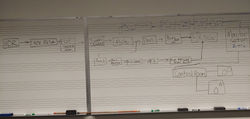 First Year Audio Recording 3 - Shoreline Community CollegeStudents generated block signal diagrams. |  Sound Design - The Art Institute of SeattleFoley Recording for class project - Howl's Moving Castle | 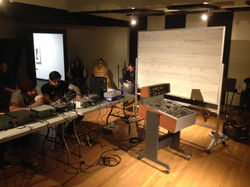 Pathways to Electronic Music - The Art Institute of SeattleStudents perform a score inspired by Stockhausen’s Studie I, using function generators and a ¼” analog tape machine. |
Sound Design - The Art Institute of Seattle
Students record Foley for Howl's Moving Castle
Fundamentals of Electronic Music - Cornish College of the Arts
Students perform Steve Reich's Pendulum Music